Technical deep dive
PDLC film – the technology behind smart glass
PDLC stands for Polymer Dispersed Liquid Crystal – an advanced material layer with microscopic liquid crystals that align electrically.
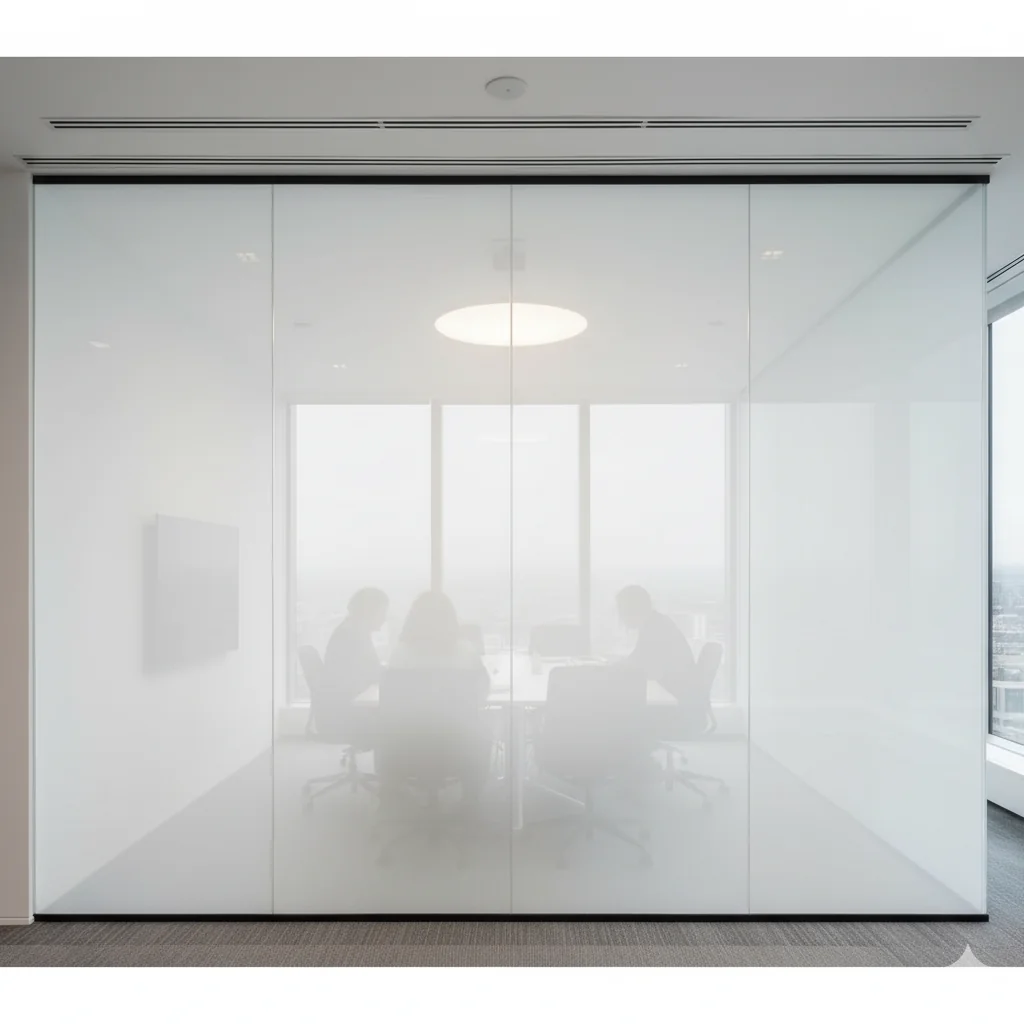
What is PDLC film?
PDLC film is a flexible polymer film containing millions of microscopic liquid crystals dispersed in a polymer matrix.
The technology was developed in the 1980s at Kent State University and has since been refined for commercial use.
PDLC film structure – layer by layer
Release liner
Outer layer removed at installation.
Optically clear adhesive
Ensures perfect adhesion to glass without bubbles or distortion.
PET substrate (upper)
Thin polyester film carrying the conductive layer.
ITO layer (Indium Tin Oxide)
Transparent conductive coating that distributes voltage evenly.
PDLC layer (the core)
Polymer matrix with liquid crystals. This is the layer that switches between clear and frosted.
ITO layer (lower)
Second electrical contact creating the AC field with the upper ITO.
PET substrate (lower)
Structural protection against mechanical stress.
The film is thin and self-adhesive and is mounted directly on your existing glass.
How PDLC technology works physically
In the PDLC layer, liquid crystals are encapsulated in microscopic droplets (5–20 μm in diameter), evenly dispersed in the polymer matrix.
Voltage on (transparent state): When 60 V AC is applied across the ITO electrodes, the electric field aligns crystals parallel with light, matching refractive index of the polymer matrix. Light passes through – 85% transparent.
Voltage off (frosted state): When power is cut, crystals randomise. Refractive index differs between crystals and polymer, scattering light in all directions. The result is a milky, opaque surface. Light is scattered, not blocked, so the room stays bright.
Technical specifications
Operating voltage
60 V AC
Power
3–5 W/m²
Light transmission on
85%
Light transmission off
55%
Max width
1 800 mm
Switching time
< 100 ms
Lifespan
50 000 h
Operating temp
-20 → +60 °C
PDLC vs SPD vs electrochromic glass
| PDLC | SPD | Electrochromic | |
|---|---|---|---|
| Switch time | 0,1 s | 1–3 s | 5–60 s |
| Price (relative) | € | €€€ | €€€€ |
| Availability | High | Limited | Limited |
| Function | Clear ↔ frosted | Clear ↔ tinted | Clear ↔ tinted |
| As film | ✓ | ✓ | ✗ |
The conclusion is clear: for privacy, PDLC is superior in price, speed and availability. For sun tinting, SPD or electrochromic may sometimes fit better.
PDLC film FAQ
PDLC film use cases
PDLC film is used in healthcare, offices, homes and retail – wherever switchable privacy is needed.
Hospitality uses PDLC for spas and hotel bathrooms; education for exam rooms; finance for board rooms; and even private jets and luxury cars.
Maintenance and cleaning
PDLC film needs minimal maintenance. Clean with a soft microfibre cloth and water or mild glass cleaner without ammonia or alcohol. Avoid blades and steel wool.
No more cleaning than regular glass. Bathrooms/kitchens: 1–2× per month. Offices: quarterly.
Safety and certification
Our PDLC film is CE marked; the manufacturer declares that it meets EU LVD and EMC directives. 60 V AC qualifies as extra low voltage per IEC. RoHS compliant for hazardous substances.
Standard PDLC has fire class B-s2,d0 per EN 13501-1. For stricter requirements we offer A2-rated upgrades.
PDLC vs traditional window film
Traditional film is permanent. PDLC is dynamic and can switch on/off as needed. Same window – clear when you want a view, frosted when you need privacy.
Want to learn more about how smart glass works in practice? Read our smart glass guide or see the PDLC price guide.